5.8.2 Facilitated Discussion
Facilitated Discussion (FD) is a voluntary service designed to address workplace relationship issues or interpersonal conflict that are acting as barriers to an injured worker's recovery and return to work (RTW Return to Work). This form of alternative dispute resolution provides a safe and supportive environment for parties to identify, discuss, and address barriers impacting recovery and RTW.
FD can be offered across either Mental Injury or Physical Injuries whereby the interpersonal conflict is a barrier to return to work.
FD may be approved where:
-
workplace relationship issues or interpersonal conflict are preventing or delaying recovery;
-
workplace relationship issues are preventing or delaying RTW; and
-
there is reasonable prospect that workplace concerns can be addressed through facilitated discussion.
Note: Participation by the injured worker and employer is voluntary.
Referral to FD may occur:
- directly by the Agent; or
- following identification of the need for the service by an OR Occupational Rehabilitation provider.
Agent considerations when referring for FD:
Before approving FD, Agents should consider:
-
whether a workplace relationship issue or interpersonal conflict is a barrier to recovery and RTW;
-
the willingness of the injured worker and employer to voluntarily participate in the process;
-
whether there is a reasonable prospect that facilitated discussion may improve recovery or RTW outcomes; and
-
whether the resolution of the workplace issue may support RTW with the pre-injury employer.
Provider requirements
FD can only be delivered by WorkSafe approved OR providers using approved Facilitated Discussion Consultants.
When the Agent approves FD, they will:
-
confirm both worker and employer are willing to participate in the voluntary service;
-
complete the Worker Choice of OR Provider requirements;
-
issue an OR Approval Form to the selected OR provider;
-
provide relevant claim, medical, and RTW information to assist service delivery; and
-
advise the worker, employer, and treating health practitioner (THP
Treating Health Practitioner) that FD has been approved.
Facilitated Discussion Process:
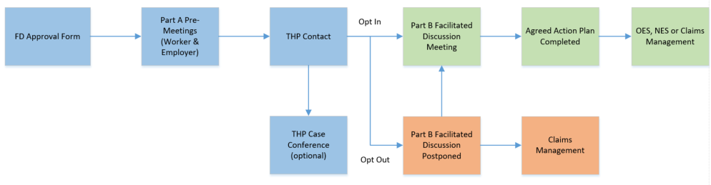
FD consists of two components:
-
Part A - Preparation (RC707)
-
Part B - Meeting (RC708)
Part A (RC707) focuses on preparation and assessment. During this stage, the Facilitated Discussion Consultant meets separately with the injured worker and relevant workplace participant(s) to understand the workplace relationship issues, identify barriers to recovery and return to work (RTW), and determine whether the parties are willing and suitable to participate in a joint mediation meeting (Part B).
Important requirements
-
A maximum of two pre-meetings are funded under FD.
-
Additional pre-meetings are not payable.
-
Initial contact to the THP is required by the OR consultant to:
-
advise the THP that their patient / the injured worker has been referred to the FD service;
-
discuss the process of the FD service; and
-
advise the THP that contact will be made with the injured worker to determine if they are agreeable to participating in the FD service.
-
-
RC707 may be billed for completed preparation activities even if a joint meeting does not proceed.
-
Part A of the FD Report must be submitted regardless of whether Part B occurs.
-
Part A of the FD Report must be distributed to:
-
the injured worker;
-
the treating health practitioner;
-
the Agent; and
-
the employer / relevant workplace party.
-
-
Part A must be completed within four weeks of receipt of the OR Approval Form.
Outcomes
Part A should identify:
-
whether FD is appropriate to proceed;
-
key workplace relationship issues;
-
potential barriers and opportunities for RTW; and
-
the readiness of parties to participate in a joint meeting.
Part B (RC708) involves a joint mediation meeting between the injured worker and relevant workplace participant(s). The FD Consultant aims to assist participants to reach a mutual agreement, address barriers impacting recovery and RTW, and develop a written Action Plan to support agreed outcomes.
Activities included
The OR provider must:
-
facilitate one or more meetings involving the injured worker and relevant workplace representatives;
-
conduct a joint facilitated discussion in a mutually agreed location;
-
ensure appropriate employer representatives attend and have authority to influence recovery and RTW outcomes;
-
discuss support person and representative options with the injured worker;
-
assist parties to develop practical and workable agreements;
-
document agreed outcomes in a written Action Plan; and
-
distribute the Action Plan and final report at service completion.
Outcomes
The goal of Part B is to:
-
resolve or reduce workplace barriers;
-
support recovery
-
develop and agreed Action Plan; and
-
facilitate a safe and sustainable RTW where appropriate.
Note: Progression from Part A to Part B is not automatic. Information obtained during Part A may identify that a joint mediation meeting is not appropriate, or that alternative strategies are required to support recovery and RTW.